
Is sustainability the same as social value?
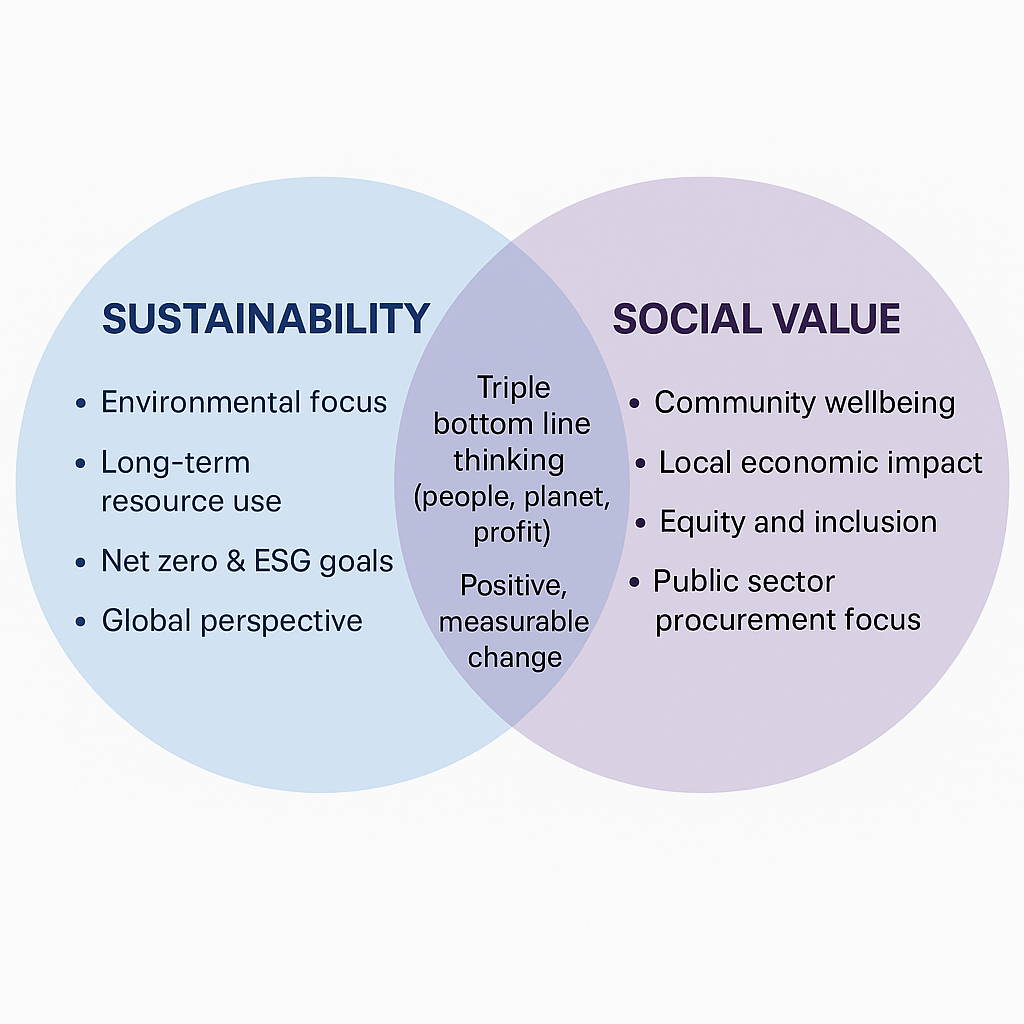
Sustainability and social value are related but distinct concepts: sustainability addresses environmental and systemic resilience, while social value focuses specifically on the outcomes experienced by people and communities.
In recent years, the terms sustainability and social value have become increasingly prominent in public policy, procurement, and business strategy. But while they're often used interchangeably, especially in tenders and ESG reports, they’re not quite the same thing. So what’s the difference, and how are they similar?
In conversations about public procurement, impact reporting, and organisational strategy, the terms sustainability and social value are often used side by side. Sometimes they’re even used as though they mean the same thing. But while they are related, they are not interchangeable.
Understanding the difference, and how they connect, is especially important for those tasked with creating meaningful change, measuring impact, or commissioning services. And central to that understanding is the role of the Theory of Change.
What do we mean by sustainability?
Sustainability is about long-term responsibility. It’s commonly associated with the environment (cutting carbon emissions, protecting biodiversity, reducing waste), but in its broader sense, sustainability also encompasses social and economic resilience. A truly sustainable approach ensures that present actions do not compromise the wellbeing of future generations.
For many organisations, sustainability is embedded through ESG frameworks, net zero strategies, or circular economy principles. It’s about doing less harm, conserving resources, and thinking long term. Importantly, while sustainability may include social outcomes, they are not always the primary focus.
What is social value?
Social value is about the additional benefits that are created for people and communities as a result of a project or investment. It is defined by the added value a contract brings beyond the core service, going further than the contract outputs alone.
This could mean creating local employment opportunities, supporting vulnerable groups, improving wellbeing, or strengthening the voluntary and community sector. Social value is people-centred and should be outcome-focused.
The role of the Theory of Change
To meaningfully define and measure social value, many practitioners use a *Theory of Change: *a structured approach that maps the logical link between activities, outputs, outcomes, and long-term impact. It helps clarify:
-
Who benefits from an activity
-
What changes occur for them
-
Why those changes matter
-
How you can evidence them
This is where social value clearly distinguishes itself from sustainability. While sustainability can often focus on high-level metrics (e.g. tonnes of CO₂ saved), social value, when guided by a Theory of Change, digs deeper into how lives are improved, for whom, and why it matters in the specific context.
For example, retrofitting homes may be a sustainable intervention, but when seen through a social value lens, its real-world impacts might include reduced fuel poverty, improved mental health, and better educational outcomes for children living in warm homes. The Theory of Change brings this human dimension to the fore.
Where sustainability and social value overlap
The two concepts are not mutually exclusive. In fact, the best initiatives often deliver both. For instance:
-
A cycling infrastructure project might reduce car emissions (sustainability), while also encouraging active travel and improving access to jobs for those without cars (social value).
-
A shift to local suppliers might reduce transport miles (sustainability), while supporting small businesses and local employment (social value).
The difference lies in the intent, the measurement, and the framing. Sustainability asks, “Are we protecting future resources?” Social value asks, “Are we improving lives, and can we prove it?”
Why the distinction matters
The table below captures the core differences between the two concepts.
| Dimension | Sustainability | Social Value |
|---|---|---|
| Primary focus | Environmental and systemic resilience | Outcomes experienced by people and communities |
| Time horizon | Long-term; protecting future generations | Near- to medium-term; measurable change now |
| Measurement unit | Carbon, biodiversity, resource use | Monetary value of outcomes (e.g. via SROI) |
| Primary question | Are we avoiding harm to the environment? | Are we improving lives, and can we prove it? |
| Typical frameworks | ESG, net zero, circular economy | SROI, Social Value Act, TOMs, SVI Principles |
| Role of Theory of Change | Often implicit | Central to evidencing causation and impact |
For commissioners, funders, and impact practitioners, it’s important not to conflate the two. Sustainability alone doesn’t constitute social value. A carbon offsetting scheme, for example, might benefit the environment globally, but may not generate local, measurable outcomes for a specific community.
Likewise, claiming social value requires evidence. A Theory of Change ensures that organisations avoid vague claims and instead make clear, grounded connections between what they do and why it matters.
In procurement, funders want to see impact that’s relevant to local needs, backed by data, and aligned with wider goals like reducing inequality or improving health. Without a Theory of Change, these links risk being superficial or assumed.
Final Thoughts
Sustainability and social value both play vital roles in shaping a better future. But they are not the same. Sustainability focuses on minimising harm and securing long-term environmental and economic resilience. Social value is about creating immediate, positive change for people and communities, backed by a clear rationale and robust evidence.
By applying a Theory of Change, organisations can demonstrate that what they did genuinely made a difference.
Frequently asked questions
Expand a question to read the answer.
Sometimes, yes, but not automatically. A sustainability activity generates social value only when it produces measurable, positive outcomes for identifiable people or communities. Planting trees to offset carbon may be a sustainability measure, but it does not constitute social value unless you can demonstrate who benefits, how, and to what extent. Where the two do overlap, a Theory of Change helps draw out the human dimension and ensures that any social value claim is grounded in evidence rather than assumption.
Stay informed
Get insights on social value delivered to your inbox