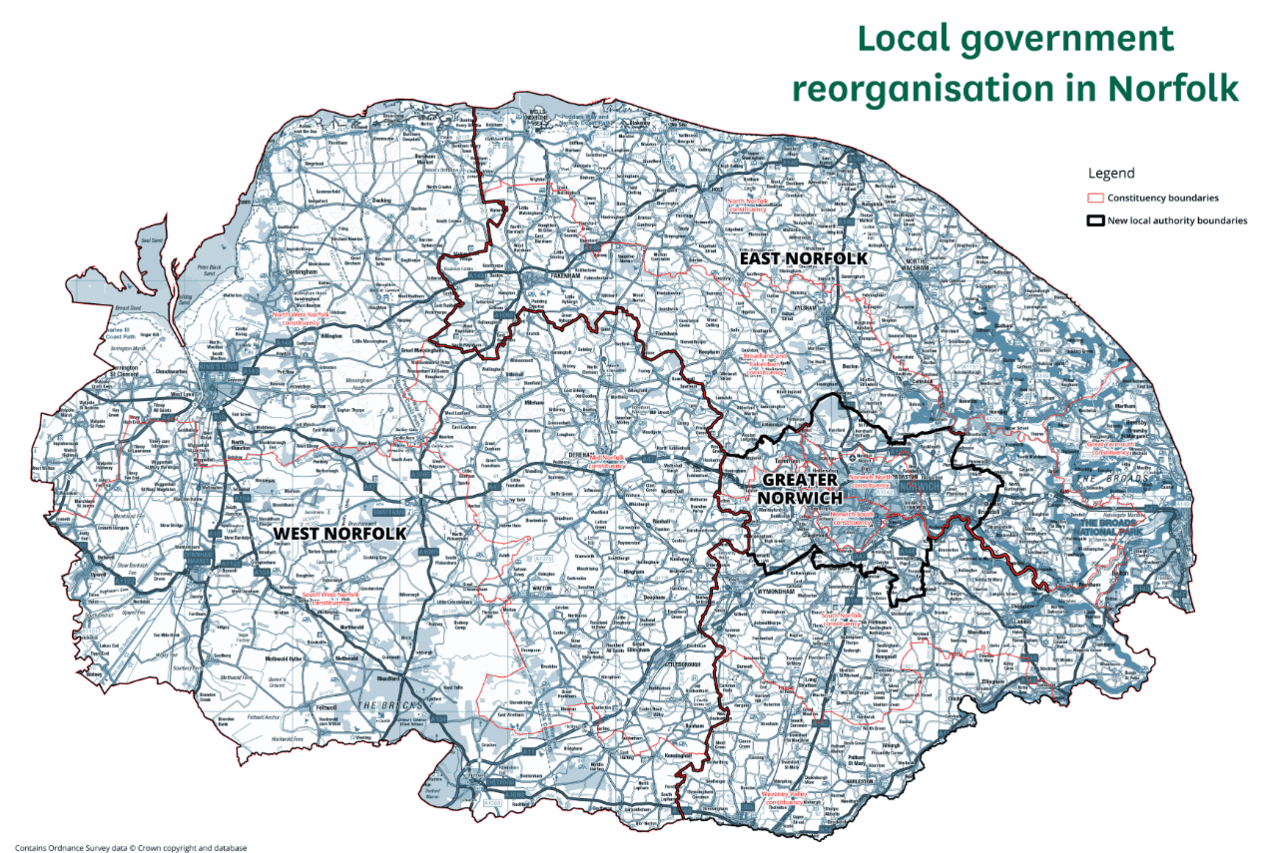
England’s local government landscape has operated on a two-tier model in many areas, with county councils responsible for services such as education, social care, and transport, and district councils handling housing, planning, and environmental health. Unitarisation removes that division, consolidating both tiers into a single authority with responsibility for the full range of local services.
Surrey is on an accelerated track. Shadow elections for East Surrey Council and West Surrey Council are scheduled for 7 May 2026, with both authorities taking on full responsibilities from 1 April 2027. Surrey is therefore in its shadow year now. For areas including Essex, Norfolk, and Suffolk, the timetable is longer: Vesting Day is April 2028, shadow elections are due in May 2027, and the formal shadow year begins after those elections. April 2026 is nonetheless a significant moment for those areas, as joint committees are now setting financial baselines and beginning to work through service integration.
The practical consequence of unitarisation is that budgets previously split across housing, social care, health, education, and community services are pooled under a single authority. That pooling changes how value is assessed, how contracts are structured, and who holds the commissioning relationship.
What this means for commissioning
The procurement consolidation that typically accompanies unitarisation has four practical implications for VCSEs and commissioning leads.
- Fewer, larger contracts. Unitary procurement tends to favour larger providers and reduce the number of small, locally-scoped contracts. Organisations that previously held direct agreements with district councils may find those pathways replaced by larger frameworks.
- Merged procurement teams. Commissioners who previously specialised in one service area will increasingly carry responsibility for cross-cutting spend. That breadth requires providers to demonstrate relevance across more than one outcome domain.
- A higher evidential bar. Unitary authorities operate under the full transparency regime of the Procurement Act 2023. Social value KPIs are tracked and published, which means organisations need evidence that holds up to scrutiny rather than reporting that satisfies a contract manager.
- The Local Outcomes Framework as the commissioning frame. The 16 priorities of the Local Outcomes Framework, launched in full in February 2026, provide the language commissioners will use to assess social value alignment. Organisations that cannot map their outcomes to the LOF will find it harder to communicate relevance.
The SROI challenge at unitary scale
A project that demonstrated clear social value to a district of 80,000 people now needs to show its contribution to a population of 500,000 or more. That requires a different kind of evidence.
Three areas require particular attention.
- Aggregating local data. Many VCSEs hold impact evidence from multiple community-level projects, each with its own reporting format. Building a coherent picture for a unitary authority means combining that evidence in a way that is consistent and credible. A shared outcomes framework, applied consistently across projects, makes this possible.
- System-wide savings. Unitary commissioners will be less persuaded by output-level reporting and more interested in the relationship between VCSE activity and downstream cost reduction. Moving from ‘we reduced anti-social behaviour on one street’ to ‘we contributed to a measurable reduction in policing and social care costs across the borough’ requires SROI methodology that applies deflation factors rigorously and attributes outcomes carefully.
- Multi-outcome positioning. Authorities that own health, housing, and employment within a single budget will look for partners able to demonstrate impact across more than one of those domains. Organisations that report against a single outcome in isolation are likely to appear narrower than they are.
For organisations using the Social Value Engine, the project structure supports this kind of multi-level analysis. Evidence gathered at community level can be organised within projects that reflect the unitary geography, and SROI calculations can be aligned with the financial proxies commissioners recognise.
The VCSE consortia model
If unitary commissioning favours larger contracts, smaller VCSEs face a genuine access risk. One practical response is the consortia model: multiple smaller organisations using a shared SROI framework to bid collectively.
A shared framework makes individual impact data aggregatable. Rather than each member presenting a separate evidence base, the consortium presents a combined picture that shows reach across a wider geography, depth of evidence across multiple outcome areas, and consistent LOF alignment across all members.
For this to work in practice, all consortium members need to be working from the same outcomes framework and applying deflation factors in the same way. Inconsistency in how deadweight, attribution, or drop-off is calculated undermines the credibility of the combined SROI figure. Establishing that consistency before the bid stage is considerably easier than trying to reconcile different methodologies under time pressure.
Lessons from Northamptonshire, five years on
North and West Northamptonshire formed as unitary authorities in April 2021, making them the most established case study available to areas now entering their shadow year. The VCSEs that navigated that transition most effectively shared a number of common characteristics.
They moved from output reporting to outcome reporting before the transition, not after. They built relationships with integrated commissioning teams early, before procurement frameworks were finalised. And they used shared frameworks to present collective evidence rather than competing individually for smaller contracts.
April 2026 marks their fifth year of operating in a unitary context. The learning from that period is directly applicable to Surrey, which enters its shadow year this month, and to Essex, Norfolk, Suffolk, and other areas where the preparation window is now open. The window is narrower than it looks: commissioning relationships and procurement frameworks established during a shadow year tend to carry through to the live authority, making early engagement disproportionately valuable.
SVE supports VCSEs in building the evidence base they need for unitary commissioning. Find out more about Social Value Engine or get in touch to discuss your organisation’s approach to local government reorganisation.