

What is Social Return on Investment (SROI)?
SROI is a methodology for measuring, valuing, and communicating the social, environmental, and economic outcomes an organisation generates. It expresses those outcomes as a ratio to investment, is grounded in eight SVI principles, and follows a structured six-stage process.
Most organisations know they create value beyond their balance sheet. The challenge is proving it in a way that is credible, comparable, and useful for decision-making. Social Return on Investment (SROI) is the methodology most widely used to do exactly that.
This guide explains what SROI is, how it works in practice, what makes it rigorous, and how it fits into the broader landscape of social value measurement in the UK.
What is SROI?
Social Return on Investment (SROI) is a methodology for measuring, valuing, and communicating the social, environmental, and economic outcomes that an organisation, project, or service generates. It expresses the relationship between the value of those outcomes and the investment required to achieve them, typically as a ratio. For example, £4.20 of social value for every £1 invested.
SROI was developed in the late 1990s by REDF, a US-based venture philanthropy fund, and has since been refined and standardised through the work of Social Value International (SVI), the global accreditation body for SROI practitioners and platforms. Social Value Engine is an SVI-accredited platform, meaning our approach is independently verified against SVI's standards.
Done well, SROI is a structured analytical process that forces organisations to think carefully about who benefits from their work, what actually changes for those people, and how much that change is worth. The ratio is a by-product of that thinking.
Forecast and evaluative SROI
There are two main types of SROI analysis, and understanding the difference matters.
Forecast SROI is conducted before or during a project. It uses evidence from similar activities to predict the likely social value that will be created. This is useful for making the case for investment, comparing options, or setting a baseline for evaluation.
Evaluative SROI is conducted after a project has been delivered, using actual data collected from stakeholders. It provides a retrospective picture of the value that was genuinely created and is the stronger basis for accountability and learning.
Both types follow the same methodology and are grounded in the same eight principles. The key difference is the source of evidence: predicted vs observed.
| Type | When conducted | Evidence source | Best suited for |
|---|---|---|---|
| Forecast SROI | Before or during a project | Secondary research; evidence from similar activities | Making the case for investment; comparing options at the planning stage |
| Evaluative SROI | After a project is delivered | Primary data collected directly from stakeholders | Accountability, learning, and external reporting |
The eight principles of SROI
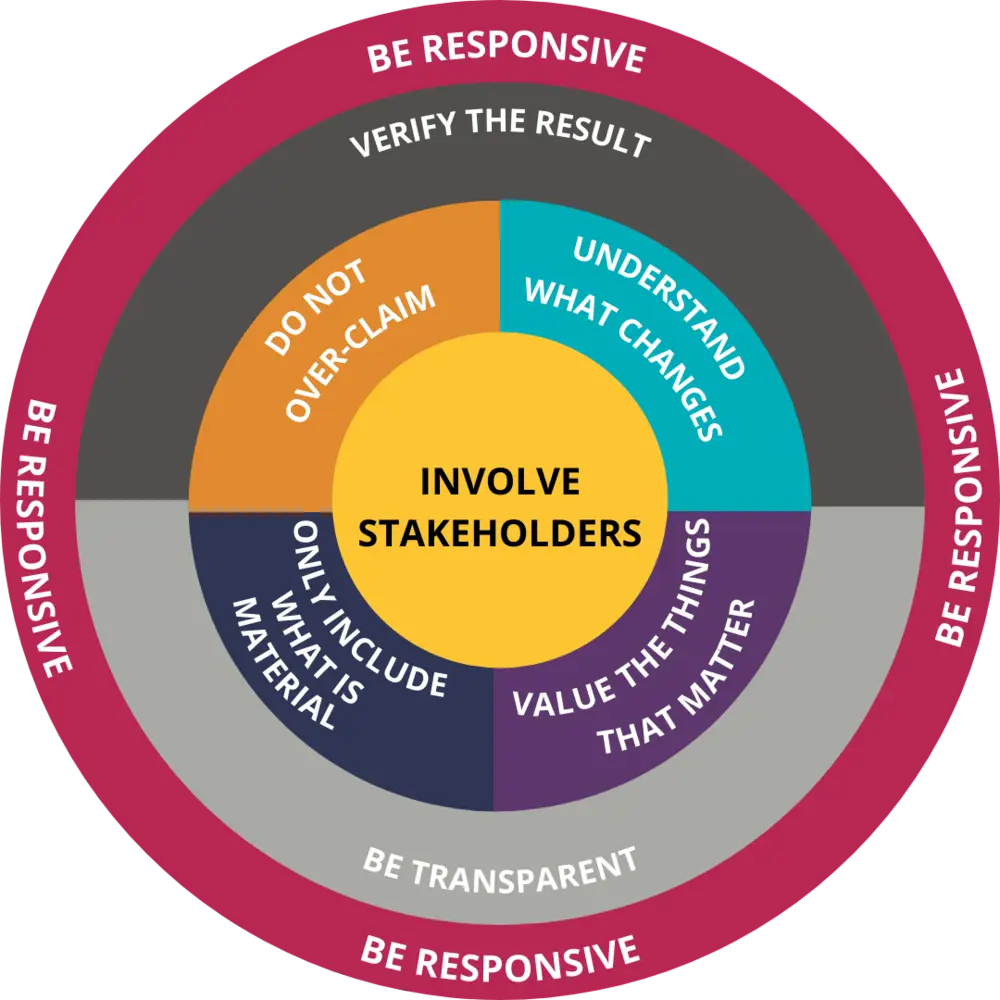
SROI is a values-based approach, grounded in eight principles developed by Social Value International. These principles are what distinguishes a credible SROI analysis from a number pulled from thin air.
1. Involve stakeholders Those who experience the outcomes of your work should shape how those outcomes are identified, described, and valued. Meaningful stakeholder engagement is where the most useful insights come from.
2. Understand what changes Change happens in complex ways. SROI requires you to think carefully about your theory of change: what inputs lead to what activities, what outputs those produce, and what longer-term outcomes result. You must also consider unintended consequences, both positive and negative.
3. Value the things that matter SROI uses financial proxies (monetary values assigned to non-financial outcomes) to make social value legible alongside economic value. By using a common language, comparison and decision-making become possible. Our guide on how to assign financial proxies to outcomes explains how proxies work in practice.
4. Only include what is material Not every outcome belongs in your analysis. Materiality means including the outcomes that would genuinely change a stakeholder's decision if they knew about them, and excluding those that would not. This requires judgement, and it is one of the places where proportionality matters most.
5. Do not over-claim SROI requires you to account for what would have happened anyway (deadweight), the contribution of others (attribution), outcomes that reduce over time (drop-off), and negative outcomes experienced by some stakeholders (displacement). This prevents organisations from taking credit for change they did not cause.
6. Be transparent Your assumptions, data sources, and decisions should be documented and open to scrutiny. Transparency is what allows others to trust your findings and to challenge them constructively. Sensitivity analysis is a key tool here, allowing you to test how your results change when assumptions are adjusted.
7. Verify the result Where possible, SROI analyses should be reviewed and verified by an independent party. SVI's assurance process provides external validation. Social Value Engine's platform supports this by creating a clear audit trail of your analysis.
8. Be responsive Social value measurement should inform decisions, then shape what comes next. Using your findings to learn, adapt, and improve is what makes the whole process worthwhile.
The six stages of an SROI analysis
An SROI analysis follows a structured six-stage process.
Stage 1: Establish scope and identify stakeholders Define what is included in your analysis: which activities, which time period, which geographies. Identify all stakeholders who experience change as a result of your work, both intended and unintended. Not all stakeholders will be included in the analysis, but all should be considered.
Stage 2: Map outcomes For each stakeholder group, identify what changes as a result of your activities. This is where you build or refine your theory of change. Outcomes should be described from the stakeholder's perspective: not as things your organisation does, but as things that change for the people you work with.
Stage 3: Evidence outcomes and give them a value Collect data to demonstrate that the outcomes you have identified are actually occurring. Then assign financial proxies to those outcomes to reflect their value. Proxies may be drawn from published research, government datasets, or the Social Value Engine's built-in proxy library.
Stage 4: Establish impact Apply the SROI adjustments (deadweight, attribution, displacement, and drop-off) to arrive at the net change attributable to your work. This is the stage that most distinguishes a rigorous SROI from an inflated impact claim.
Stage 5: Calculate the SROI Divide the total value of outcomes by the total investment (including in-kind contributions) to arrive at the SROI ratio. A ratio of £3:£1, for example, means that for every £1 invested, £3 of social value is generated.
Stage 6: Report, embed, and use the findings An SROI analysis is only useful if its findings are acted upon. Report the results clearly to stakeholders, use them to inform strategic decisions, and embed the process into your regular practice. The findings should also be used to set targets for future improvement.
What makes a good SROI analysis?
Three things distinguish credible SROI from low-quality impact theatre.
Genuine stakeholder involvement. The outcomes in your analysis should reflect what stakeholders actually say changes for them, not what your organisation assumes or hopes they experience. This requires real engagement, not a survey sent after the fact.
Conservative assumptions. The adjustments at Stage 4 exist for a reason. An analysis that claims 100% attribution and zero deadweight will not survive scrutiny. Good SROI analysts are deliberately conservative, and then use sensitivity analysis to show how results change under different assumptions.
Proportionate effort. A £10,000 project does not require the same depth of analysis as a £10 million contract. Proportionality means matching the rigour of your approach to the scale of the decision it will inform.
How SROI compares to other approaches
SROI is one of several frameworks used to measure social value in the UK. Understanding where it sits is useful for practitioners and commissioners alike.
SROI vs TOMs. The Themes, Outcomes and Measures (TOMs) framework is widely used in public procurement, particularly in England. It produces a monetised social value score using a standardised menu of outcomes, which makes comparison across suppliers straightforward. SROI produces a more tailored, theory-of-change-driven analysis. The two approaches can complement each other. Our article on the difference between SROI and the TOMs framework explores this in more detail.
SROI vs WELLBYs. Wellbeing-Adjusted Life Years (WELLBYs) are increasingly used in government evaluation, particularly in health and social care. They measure improvements in subjective wellbeing using standardised survey questions. Like SROI, they assign a monetary value to outcomes. The two approaches share a common commitment to valuing what matters but differ in their evidence base and scope. See our piece on WELLBYs and SROI for a fuller comparison.
SROI differs from both in that it is a full analytical methodology rather than a reporting framework. It is more demanding to conduct properly, but it produces findings that are more defensible and more useful for decision-making.
| Framework | Unit of measurement | Stakeholder engagement | Best suited for | UK policy context |
|---|---|---|---|---|
| SROI | Monetary ratio (e.g. £4 per £1 invested) | Yes, essential | Full impact analysis, strategy, and evaluation | Social Value Act 2012; SVI Principles |
| TOMs | Monetised activity scores | Not required | Procurement bid scoring across suppliers | Social Value Model (PPN 002, England) |
| WELLBYs | Wellbeing-Adjusted Life Years | Yes, survey-based | Health and social care evaluation | HM Treasury Green Book; Magenta Book |
SROI and the policy context
SROI has been shaped by, and continues to shape, public policy around social value in the UK.
In England, the Social Value Act 2012 requires public bodies to consider social value in procurement decisions. The government's Social Value Model (updated in 2025 via PPN 002) sets out how social value should be evaluated in central government contracts. SROI provides the analytical rigour that these policy requirements call for but rarely specify.
In Scotland, the Community Wealth Building (Scotland) Bill represents a significant shift in how public investment is understood and measured. It places a duty on local authorities to develop community wealth building strategies, with social value measurement playing a central role in evidencing outcomes. Our article on the Community Wealth Building Bill explains what this means in practice for third sector organisations and public bodies.
Across the UK, growing pressure on public finances has made the case for robust social value measurement more urgent, not less. Commissioners need to demonstrate that every pound of public money is generating maximum benefit. SROI provides a framework for making that case, and for comparing options at the point of investment.
Who uses SROI and why
SROI is used across the public, private, and third sectors, for a wide range of purposes.
- VCSE organisations use SROI to demonstrate impact to funders and commissioners, strengthen grant applications, and make the case for continued investment. See how Devon Communities Together used the Social Value Engine to evidence the value of their work.
- Local authorities use SROI to evaluate the outcomes of commissioned services, justify spending decisions, and embed social value into procurement processes. East Riding of Yorkshire Council is one of the most comprehensive examples of SROI in local government.
- NHS and social care organisations use SROI to evidence the wider determinants of health and demonstrate the value of preventative interventions.
- Funders and grant-making bodies use SROI to assess applications and evaluate the impact of their portfolios. Our guide on evaluating grant applications for real social value is useful for those on the funding side.
- Private sector organisations use SROI as part of their ESG and corporate social responsibility reporting, and increasingly to respond to social value requirements in public sector tenders. It is also worth understanding how social value and sustainability relate, and where they differ.
- Further education providers — colleges, training organisations, and apprenticeship providers — use SROI to evidence the social return of learning programmes for learners, local employers, and the wider community. See our Further Education sector page for how Social Value Engine supports FE providers specifically.
SROI in practice
The ratios below come from real analyses conducted on the Social Value Engine. Each reflects a specific programme type and shows what a rigorously deflated result looks like when deadweight, attribution, and drop-off have been applied.
Devon Communities Together | SROI: £3.78 per £1 invested
Devon Communities Together used the Social Value Engine to measure outcomes across their rural community portfolio, covering digital inclusion, transport access, and village hall support. The analysis applied conservative deflators throughout, with the resulting ratio providing the auditable evidence their local authority and trust funders required to justify continued investment in rural community development.
East Riding of Yorkshire Council | SROI: £5.40 per £1 invested
East Riding of Yorkshire Council used the Social Value Engine to evaluate a targeted homelessness outreach programme. The high ratio reflects the substantial financial proxies associated with homelessness prevention, including avoided temporary accommodation costs and improved long-term health outcomes, offset by conservative attribution and deadweight assumptions throughout.
Cheshire Community Action | SROI: £4.95 per £1 invested
Cheshire Community Action applied the platform to their hospital-to-home transition service, which supports people to return safely home following a hospital stay. The analysis combined avoided readmission costs with wider wellbeing and independence outcomes, producing a ratio that has been used in direct conversations with NHS commissioners to justify continued service investment.
Common pitfalls in SROI
Even well-intentioned analyses can go wrong. The most common problems are:
Inflated ratios. An SROI of £25 for every £1 invested is almost certainly wrong. Very high ratios are usually a sign that deadweight, attribution, or drop-off have not been properly applied, or that proxies have been chosen without sufficient care. A credible ratio requires honest deflation.
Weak stakeholder engagement. An analysis that identifies outcomes from a desk review rather than from conversations with the people affected is less likely to capture what actually matters, and less likely to be trusted by the people who read it.
Proxy selection without justification. Choosing a financial proxy because it produces a high number, rather than because it accurately represents the value of the outcome to the stakeholder, undermines the whole analysis.
Treating the ratio as the output. The SROI ratio is a summary, not the purpose. The real value of the process is in the understanding it generates: which outcomes matter most, which are most cost-effective, and where the organisation should focus.
Getting started with SROI
By using SROI, organisations can move from describing their impact to demonstrating it, with evidence that is transparent, proportionate, and built on what stakeholders actually experience.
Social Value Engine's platform is designed to make this process manageable, whether you are conducting your first analysis or embedding SROI across a portfolio of programmes. Get in touch to find out how we can help, or explore the Knowledge Base for further reading on the methodology.
Frequently asked questions
Expand a question to read the answer.
Traditional Return on Investment (ROI) measures financial returns relative to financial costs. SROI uses the same basic structure (value out divided by investment in) but expands what counts as value. It includes social, environmental, and economic outcomes experienced by stakeholders, not just financial returns to the organisation. A business generating profit can have a low SROI if its activities cause harm elsewhere; a charity with no revenue can have a high SROI if it creates substantial, evidence-based value for the people it serves. For a broader definition of what that value represents, see our guide on what social value is.
Stay informed
Get insights on social value delivered to your inbox